

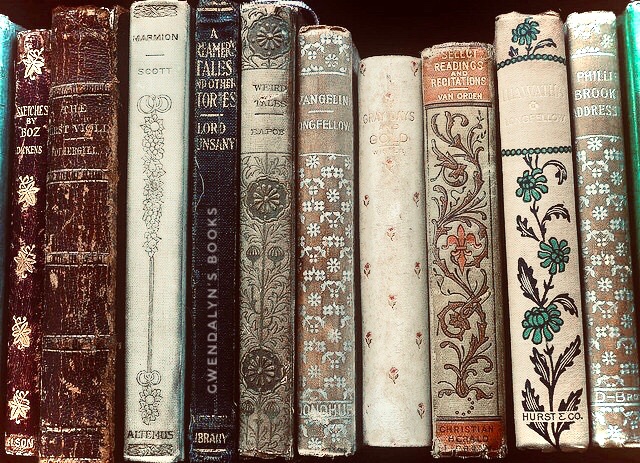
Hello Today I Decided to take down one of my beautiful antique books to share with you. I have been avid collector of Antique and vintage books for various reasons since childhood.
Today I am featuring The Poet Mr Joh Keats and His love for Miss Fanny Brawne. So grab yourself a cuppa and join me

John Keats
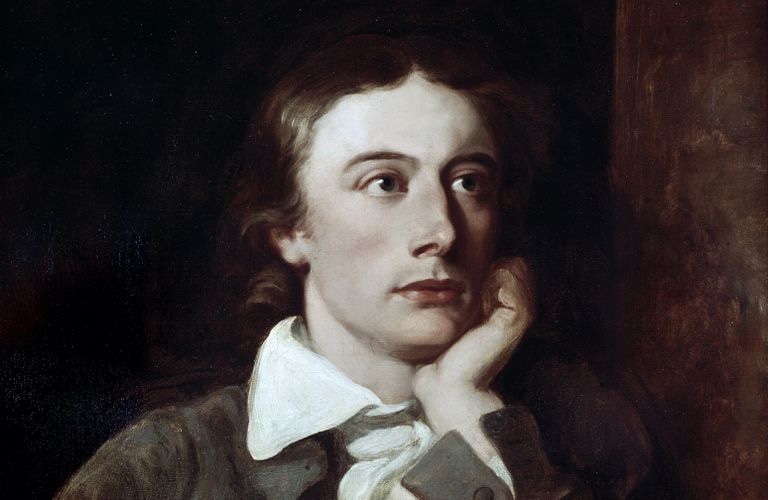
Portrait of English Romantic poet John Keats 1795-1821, by English painter William Hilton National Portrait Gallery, London
Today I want to share with you some my ramblings, in particular I have a a question for you. Have you ever read any of the classics. I know most of us have had to read some sort of classical lit for school or such.
My question really is have picked up on your own and read a piece of classical literature, from a novel or a a delightful book of poetry.
My Mother was an avid reader, so I was introduced early on to classical literature along with, and I kid you not Fantasy and Science Fiction.
You would be surprised how easy it is to transition from one to the other.
So this post is particularly about John Keats, and his poetry, along with his love interest. Which I found to have influenced his writing. Maybe not so much is rattled him into putting forth more of effort to write.
His poetry is really fantastic, in its way of imagery, and I am all about forgetting about what’s going on in the world today. I want to be transported into a book or poem.. something that allows me Escape.

Despite his death at the age of 25, Keats is one of the greatest English poets and a key figure in the Romantic movement.
He has become the epitome of the young, beautiful, doomed poet.
John Keats was born on 31 October 1795 in London. His father worked at a livery stable, but died in 1804. His mother remarried, but died of tuberculosis in 1810.
Keats was educated at a school in Enfield. When he left at 16, he was apprenticed to a surgeon. He wrote his first poems in 1814. In 1816, he abandoned medicine to concentrate on poetry. His first volume of poetry was published the following year.
In 1818, Keats nursed his brother Tom through the final stages of tuberculosis, the disease that had killed their mother. Tom died in December and Keats moved to his friend Charles Brown’s house in Hampstead. There he met and fell deeply in love with a neighbour, the 18-year old Fanny Brawne.
This was the beginning of Keats’ most creative period. He wrote, among others, ‘The Eve of St Agnes’, ‘La Belle Dame Sans Merci’, ‘Ode to a Nightingale’ and ‘To Autumn’. The group of five odes, which include ‘Ode to a Nightingale’, are ranked among the greatest short poems in the English language.
From September 1819, Keats produced little more poetry. His financial difficulties were now severe. He became engaged to Fanny Brawne, but with no money there was little prospect of them marrying.
Early in 1820, Keats began to display symptoms of tuberculosis. His second volume of poetry was published in July, but he was by now very ill. In September, Keats and his friend Joseph Severn left for the warmer weather of Italy, in the hope that this would improve Keats’ health. When they reached Rome, Keats was confined to bed. Severn nursed him devotedly, but Keats died in Rome on 23 February 1821. He was buried in the Protestant Cemetery in Rome.
John Keats’s Style Poems
Keats’s diction is highly connotative.
His writing style is characterized by sensual imageryand contains many poetic devices such as alliteration, personification, assonance, metaphors, and consonance.
All of these devices work together to create rhythm and music in his poems. His most popular poems include:
Ode on Melancholy,
Ode on a Grecian Urn
Ode to Autumn
Ode to a Nightingale
La Belle Dame Sans Mercy
Imitation of Spenser
Hyperion,” and “Isabella.
Among his sonnets, the most popular are
“Bright Stars! Would I were steadfast as Thou Art,” “When I have Fears that I may Cease to be,” “Endymion,” “The Eve of St. Agnes,” and “Lamia.”
More About Him
Keats did not harness dramatic and narrative power necessary to present individual characters. Instead, he was gifted with lyrical power to present characters with expressive moods. Often, these moods were of pensiveness, romantic sadness, or indolence, as well as ecstatic delight, which can be observed in his great odes.
To Autumn” (1819)
This poem’s first line is one of the most iconic of all time.
Arguably, no other poet has managed to create such a beautiful depiction of the season so deftly, or with such a kaleidoscopic wealth of images.
Keats is able to convey the synaesthesia of three months in just three stanzas.
The naturalistic, almost pastoral language is reminiscent of Hardy in places, though achieves as much with a fraction of the words.
Season of mists and mellow fruitfulness,
Close bosom-friend of the maturing sun;
Conspiring with him how to load and bless
With fruit the vines that round the thatch-eves run;
To bend with apples the moss’d cottage-trees,
And fill all fruit with ripeness to the core;
To swell the gourd, and plump the hazel shells
With a sweet kernel; to set budding more,
And still more, later flowers for the bees,
Until they think warm days will never cease,
For summer has o’er-brimm’d their clammy cells.
Who hath not seen thee oft amid thy store?
Sometimes whoever seeks abroad may find
Thee sitting careless on a granary floor,
Thy hair soft-lifted by the winnowing wind;
Or on a half-reap’d furrow sound asleep,
Drows’d with the fume of poppies, while thy hook
Spares the next swath and all its twined flowers:
And sometimes like a gleaner thou dost keep
Steady thy laden head across a brook;
Or by a cyder-press, with patient look,
Thou watchest the last oozings hours by hours.
Where are the songs of spring? Ay, Where are they?
Think not of them, thou hast thy music too,—
While barred clouds bloom the soft-dying day,
And touch the stubble-plains with rosy hue;
Then in a wailful choir the small gnats mourn
Among the river sallows, borne aloft
Or sinking as the light wind lives or dies;
And full-grown lambs loud bleat from hilly bourn;
Hedge-crickets sing; and now with treble soft
The red-breast whistles from a garden-croft;
And gathering swallows twitter in the skies.
Bright Star by John Keats Poetry Analysis
Bright Star by John Keats Poetry Analysis – Quillsliteracy
This essay is a close reading analysis of the poem
“The Bright Star”.
It is a love sonnet and is believed that it was written for his love and fiance’ Fanny Brawny. Keats writes the poem in iambic pentameter. The poem revolves around Keats love for stars and about nature’s beauty. The whole poem is written with a rhyming scheme except the last two lines possibly to attract the reader’s attention to it.
By starting the poem with “Bright Star! “
Keats introduces the poem with strong imagery and symbolism that rejects a clear and precise picture of the bright star. By adding an exclamation to the line, he stresses the importance of the star and to exhibit the excitement he is feeling. He wishes that he could be as steadfast and consistent as the bright star. In the second line, he writes about the lonely star that is isolated from the rest of the world. Even though he admires the star and wishes to be like it, he doesn’t want to follow this quality of the star.
The third line – expresses that the star is always awake and shining and that is yet another characteristic he doesn’t wish to imitate. In line our, Keats writes about a “sleepless Eremite” which is another word for hermit. Comparing eremite to the “moving waters” captures beautiful imagery. This is the first time Keats uses religion in the poem. However, he does use it a few times throughout the poem. The poet uses the poetic device simile in the fifth line by comparing the moving waters to “Priestley task”.
This contributes to the fact that John Keats loves and admires the beauty of nature (“moving waters”) as he is comparing it with a religious symbol (“Priestley task”). The religiousness was being compared to the star, and now it is being compared to the moving waters. It shows a separation between the sky and the Earth. With the imagery of “Eremite” and “Priestley tasks” of moving waters, Keats wishes to express that the stars and the nature of water bodies are always twinkling and flowing, basically being immortal, which he cannot accomplish.
In line six- Keats uses the word “ablution” which also symbolizes religion. Ablution is a word for religious washing or cleansing and Keats ties it with the sea. All the lines so far in the poem express the profound admiration that Keats has for the skies and the Earth, since he compares them with elisions values. Keats brings back the stars and its gazing once again in line seven. He uses enjambment to create a pause from the stars and waters to transform into other earthly bodies.
Keats starts this new stanza by expressing his admiration for mountains and moors and the beautiful snow that accumulates on top of its peak. He tries to create imagery of a winter and lonely place. Winter has a connotation of seclusion and desolation. One can also find alliteration in mountains and moors, trying to stress his adoration for them. Keats repeats what he expresses n the beginning of the poem again in line eight saying that he wants to be steadfast and “unchangeable” like the star, but not lonely.
This repetition enforces the passion he for the star. He writes about him lying on his lover’s breast and seeking comfort. He mentions “ripening” breast to express that even if the breast is aging, the comfy it produces does not lessen. This can be compared to the star, which also has its comfort and beauty no matter it’s age. Keats ends the poem by saying, “so live ever- or else swoon to death”. He expresses that he would be happy to live with his love and swoon to death or live forever like the star.
 The gravestone of poet John Keats, (1795-1821), stands in Rome’s ‘Non Catholic Cemetery’ on March 26, 2013 in Rome, Italy
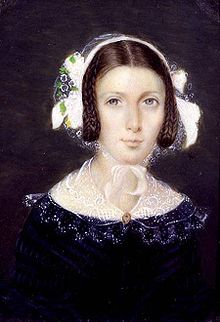
Keats & Fanny
THE LOVE affair between John Keats and Fanny Brawne was shortlived but burned intensely bright.
They met in 1819 when they were neighbours in Hampstead but were separated for ever when Keats departed for Italy in September 1820 hoping the warmer weather there might alleviate the symptoms of his tuberculosis.
He died in Rome in February 1821, aged just 25.
The poems he wrote during that time (including his best known works Ode To A Grecian Urn, Ode On Melancholy and Ode To A Nightingale) are among some of the best loved in the English language but the passionate letters he and Fanny exchanged give us a unique insight into their love affair.
When they met, Fanny was just 18 and Keats described her as “autiful, elegant, graceful, silly, fashionable and strange”. He considered her passion for clothes to indicate someone a little too vain and flirtatious to be taken seriously but soon grew to see it as an expression of her bold and irrepressible nature, calling her his “minxtress”.
In March 1820 he wrote her a letter saying: “You are always new… the last movement always the gracefullest.”
In the early 19th century it was not considered desirable for women to be too clever or too educated. Fanny shared what Bright Star’s director Jane Campion calls the “passive waiting fate of any young woman of her time”. Yet she was obviously bright and if poetry was Keats’s way of expressing himself and making sense of the world around him, so fashion was Fanny’s.
It was obviously a passion that she developed at a young age since a collection survives of fashion plates clipped from such magazines as Petit Courrier des Dames (a French publication, the early 19th-century equivalent of Vogue), which she starting making at the age of 12. Fanny continued to amass these illustrations until just two years before her death in 1865.
When Keats first encounters his neighbour in Campion’s film she is wearing a white dress with a vibrant red cardigan and an attention-seeking feathered hat.
The dress itself is copied from one in Fanny’s collection. White dresses were de rigueur for young women at the time but it was only just becoming acceptable to pair them with colours: a white skirt with a coloured “body” was considered daring.
Janet Patterson, costume designer for Bright Star took inspiration from Fanny’s books of fashion plates. Some of the costumes are on show at Keats House, the museum that now occupies the semi-detached Hampstead house in which the poet used to live. It was owned by his friend Charles Brown who let a room to Keats with the Brawne family occupying the other side.
Katherine Pearce of Keats House says:
“It was just after the Battle of Waterloo so the French look was very fashionable and military detailing on clothes for women was also something that was popular”.
Katherine Pearce, “I don’t so much see Fanny as his muse more someone who shook him up. Before he met her he had been writing about his surroundings and theoretical ideas of truth and beauty but the depth of his feelings for her frightened him and he was forced to confront things in a very personal way.”
Fanny did eventually marry and have children but she always wore the engagement ring Keats had given her. a garnet set in gold scrollwork, it undoubtedly set off her many elegant outfits.
The Keats House is open Friday to Sunday.
Visit keatshouse.cityoflondon.gov.uk

Location: Fanny Brawne’s Room, Keats House, Hampstead
Description: This is the engagement ring given to Fanny Brawne by the poet John Keats in 1819, probably in sometime in the Autumn of that year. (1) The ring was probably made in the late eighteenth century, and the stone is almandine – a type of garnet – set in a gold openwork scrolled shouldered hoop.
Now on to the movie Bright Star, which I finally watched.I have to say it’s really breathtaking in the cinematography, along with Keats poems and love letters to Fanny Brawne. It’s actually swoon worthy.
I think it’s by far one of the most romantic period pieces I have come across in historical cinematography.
Maybe it’s the lighting or the nature, or maybe it’s the dress. The acting, Not sure.. but I love it
Bright Star is a 2009 British-French-Australian biographical fiction romantic drama film based on the last three years of the life of poet John Keats and his romantic relationship with Fanny Brawne. It stars Ben Whishaw …
Have






 Gwendalyn’s Books