Book Tours

Behind the Scenes of Charles Dickens’ ‘A Christmas Carol’

Written By Nancy Bilyeau

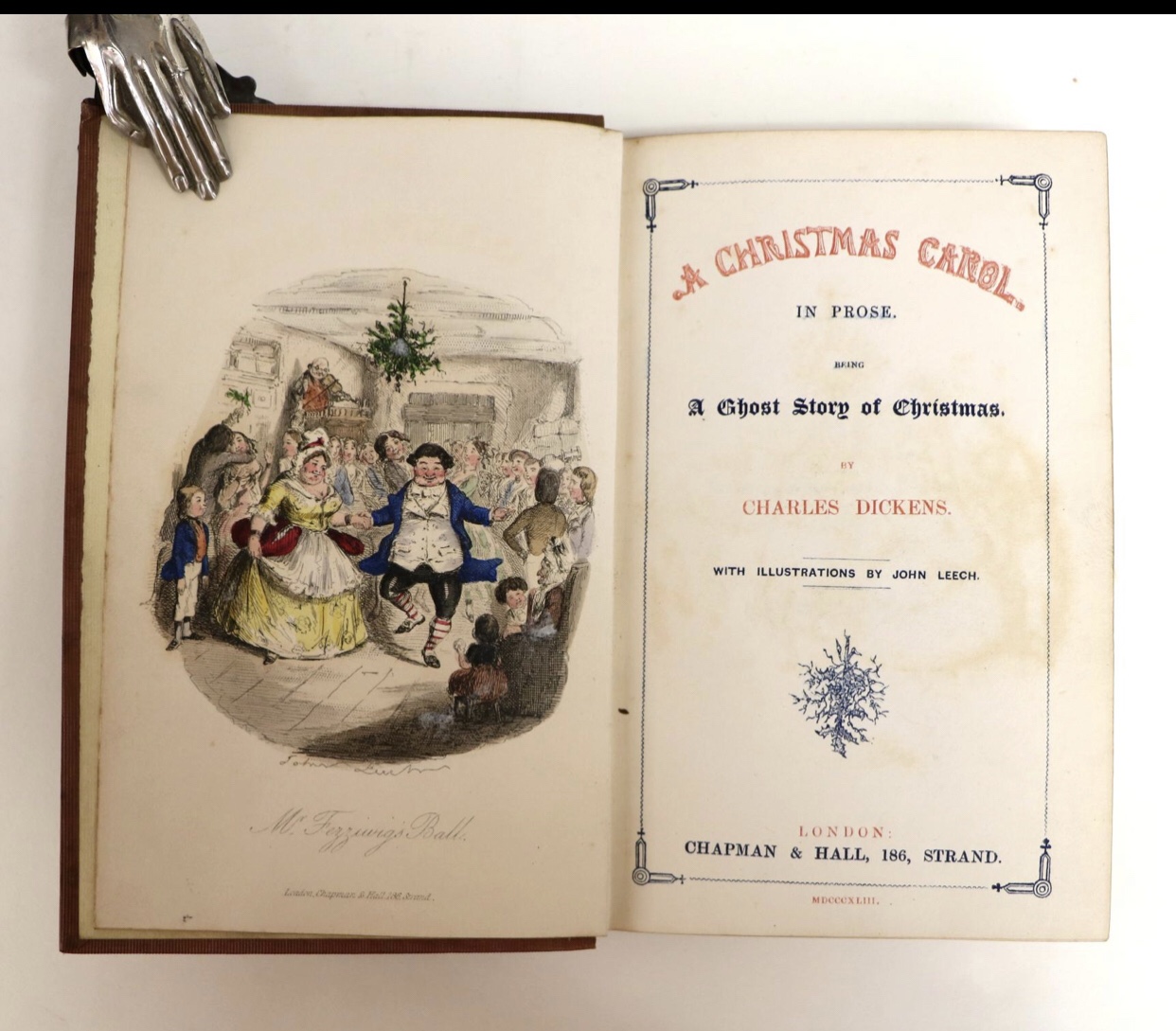
It may well be the most beloved Christmas story ever written. Charles Dickens’ novella, originally titled Christmas Carol. In Prose. Being a Ghost Story of Christmas, was published on December 19, 1843, and sold 6,000 copies by Christmas Day. It has never gone out of print and is the basis for countless adaptations, giving way to debates over who is the best Ebeneezer Scrooge: Alastair Sim or Reginald Owen, George C. Scott or Patrick Stewart.

Autographed manuscript of the title page of ‘A Christmas Carol,’ signed by Dicken. Purchased byJohn Pierpont Morgan before 1900. Image courtesy of Morgan Library & Museum Media Department.While the story itself is both touching and mythic, taking a closer look at Dickens’ decision to write the book and the personal history that he poured into it is illuminating.
Dickens, to put it bluntly, wrote A Christmas Carolbecause he needed the money. He’d found literary fame due to the success of  The Pickwick Papers and Oliver Twist, but his new book,  Martin Chuzzlewit, was not as successful.
Dickens had a wife and four children to support; his wife, Catherine, was pregnant with their fifth. He came up with the idea to rent the family’s London home and live on the Continent for a year. A Christmas Carol was written to fund this move. A story of spirits who appear at Christmastime was not invented by Dickens. For centuries, during the longest and darkest nights of the year, it was thought that the barrier between this world and the afterlife was at its thinnest. This was the time for ghosts to show themselves to the living.

The original cover of A Christmas Carol. Dickens insisted that it be bound in crimson morocco, a  durable goatskin leather. The binding is elegantly decorated in gilt with the name “Thomas Mitton Esqre.” Dickens presented the bound manuscript to Mitton, his close friend and creditor, possibly as a Christmas gift. From the J.P. Morgan collection, courtesy of the Morgan Media Department 
Dickens penned the book in six weeks. He wrote in a concentrated burst from 9 am to 2 pm every day. Writing would be followed by long brainstorming walks.

He scribbled many notes in the margins as he went, making swift corrections. According to curators of a Dickens exhibit at the Morgan Library & Museum, owner of the original manuscript, “Deleted text is struck out with a cursive and continuous looping movement of the pen and replaced with more active verbs—to achieve greater vividness or immediacy of effect—and fewer words for concision. This heavily revised sixty-six-page draft—the only manuscript of the story—was sent to the printer in order for the book to be published on 19 December, just in time for the Christmas market.”

Page 2 of the original manuscript of A Christmas Carol,
showing Dickens’ corrections. 
From the collection of the Morgan Library & Museum, 
image courtesy of the Media Department 
Literary historians believe that because he needed to write so fast, Dickens wrote about a topic close to his heart. He fueled the story with his own feelings about the terrible conditions for the poor in England. The 1834 New Poor Law went far toward criminalizing poverty. Dickens was furious about the grim fate of the working class, and he used this novella to write about it.
As for the book’s characters, debates go on about which real-life “misers” Dickens based the elderly Ebeneezer Scrooge on or his partner Jacob Marley. When it comes to the younger Scrooge, though, Dickens’ own youth can be seen in glimpses. His years of loneliness and resentment come through.
In the story, the boy Ebeneezer Scrooge has been sent away to a boarding school (one with dirty rooms and cracked windows) by a father who seems to want nothing to do with him.

 Dickens had a complicated relationship with his father, John Dickens. When he was 12, Charles Dickens was removed from school and forced to work at a blacking factory for 10 hours a day, six days a week. The reason: his father, John Dickens, had been sentenced to Marshalsea Prison because he was unable to pay a debt of 40 pounds; his wife and younger children joined him there, while Charles lived alone in lodgings. 
This means that when still a child, Charles Dickens was under intense pressure to make money and relieve this debt. It was the family’s only way out of prison. These memories never left Dickens: “My whole nature was so penetrated with grief and humiliation,” he told a friend.

Charles Dickens, 
photo courtesy of the Morgan Library & Museum, media department.The character of Bob Cratchit, Scrooge’s weak, hapless, but warm-hearted clerk, bears some resemblance to Dickens’ father. A crucial character in A Christmas Carol is Scrooge’s older sister Fan, who is the only person to love him unconditionally but dies as a young woman after giving birth to her son, Fred.

“Always a delicate creature, whom a breath might have withered,” said the Ghost. “But she had a large heart.”
“So she had,” cried Scrooge.

Fan, it seems clear, was based on Dickens’ older sister Frances, known in the family as Fanny, who was close to her brother when they were children. 
She was “clever and accomplished,” according to Dickens biographer Claire Tomalin. A talented musician,  in 1823 she became a student at the Royal Academy of Music in London.  She was expected to become the star of the family, not Charles. Biographers believe that he was envious of Fanny.

According to the Charles Dickens Museum, “Fanny’s schooling was, however, often marred by her father’s inability to pay her fees. A letter survives from John Dickens, dated 25 May 1826, in which he suggests a payment plan, offering to pay ‘£10 quarterly from the 24th June next and the same to continue until the account is finally closed.’ “
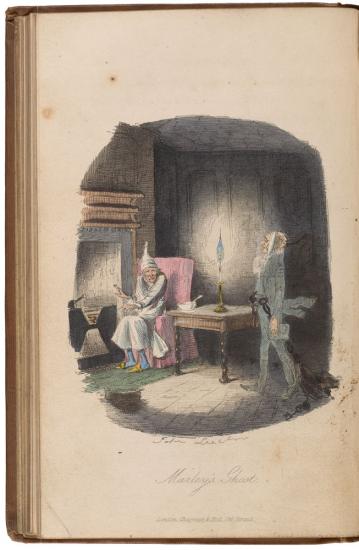
 Christmas Carol, London: Chapman & Hall, 1843
Illustration by John Leech depicting Marley’s Ghost. 
Photo courtesy of Morgan Library & Museum, media departmentFanny did have a career as a professional singer, with a “pure” singing style. In 1837, she married a fellow musician and they settled in Manchester. The couple had two sons. “Once Fanny Dickens married and had children, her career declined,” wrote Tomalin.
Fanny became ill with tuberculosis. One of her children, Harry, was a bright child who suffered from a physical handicap. When Fanny died, Harry passed away shortly afterward at the age of 8. Some speculate that the child was the inspiration for Tiny Tim.
Such family tragedies would seem to provide strong inspiration for Dickens in his character creations of Fan and Tiny Tim. What is chilling is that Fanny and Harry died years after Dickens wrote A Christmas Carol.  
By the time his sister fell ill, Dickens was in a much better financial position. He hired the best doctors for Fanny, but nothing could save her. She died at the age of 38 on September 2, 1848. Dickens arranged for her burial in Highgate Cemetery. Harry was buried there too, as were Charles Dickens’ parents and other members of his family.

Charles Dickens, the great writer, did not join them. He is buried elsewhere.

Highgate cemetery, where many members of Dickens’ family were 
buried, including his sister Fanny and his nephew Harry
Book Tours

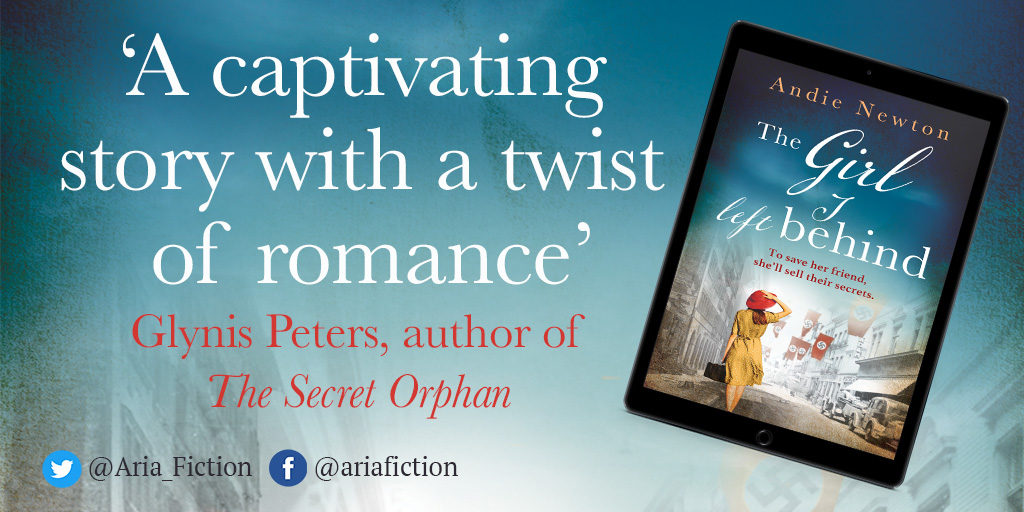
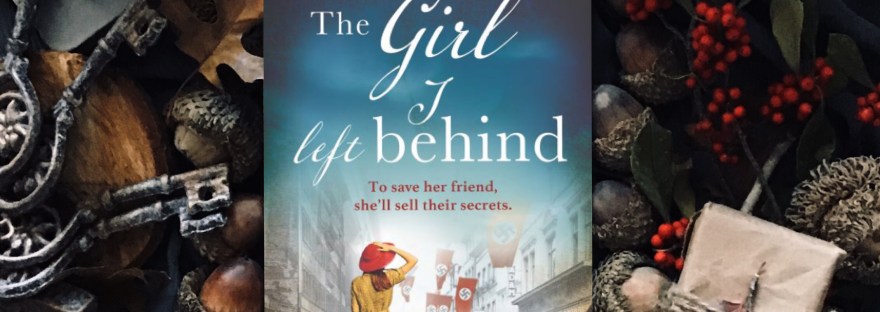
Blog Tour The Girl I Left Behind

Today I’m really excited to be taking part in the Book Tour of, The Girl I left Behind by Andie Newton , which is being hosted by HFBT!

The Girl I Left Behind by Andie Newton

Publication Date: October 3, 2019
Aria Fiction
eBook & Paperback; 368 Pages
Genre: Historical Fiction

What would you risk to save our best-friend?

As a young girl, Ella never considered that those around her weren’t t as they appeared. But when her childhood best-friend shows Ella that you can’t t always believe what you see, Ella finds herself thrown into the world of the German Resistance.

On a dark night in 1941, Claudia is taken by the Gestapo, likely never to be seen again, unless Ella can save her. With the help of the man she loves, Ella must undertake her most dangerous mission yet and infiltrate the Nazi Party.

Selling secrets isn’t an easy job. In order to find Claudia, Ella must risk not only her life, but the lives of those she cares about.

Will Ella be able to leave behind the girl of her youth and step into the shoes of another?

Perfect for fans of The Tattooist of Auschwitz, The German Midwife and Kate Furnivall.

Available on Amazon | Barnes and Noble | Apple iBooks | Kobo

Praise for The Girl I Left Behind

A gripping historical page-turner about an audacious eighteen-year-old girl in Nazi Germany, who finds herself at the heart of the Reich. Its a thrilling tale of female friendship, young love, and extraordinary courage, laced with chilling reminders of the fate Ella will face if her treachery is discovered. A powerful debut!’ Gill Paul, USA Today bestselling author of The Secret Wife.

A captivating story with a twist of romance threaded throughout, Glynis Peters, USA Today bestselling author of The Secret Orphan.

A compelling tale of friendship, courage and espionage in a frightening and uncertain world, Charlotte Betts, author of The Dressmakers Secret.

The Girl I Left Behind made me cry and left me wanting more, which to me are signs of a truly wonderful book, one that will stay with me long after Ive finished reading, Lana Kortchik, author of The Story of Us.

Today I’m really excited to be taking part in the Book Tour of, The Girl I Left Behind. Complimentary copy of the book provided by publisher, Atria Books in partnership with HFVBT, in exchange for an honest review. All opinions are my own

An riveting exciting World War II, Historical Fiction novel that takes the reader deep within the underground of the German Resistance.

Germany between 1933 and 1945 was transformed into a totalitarian state. where nearly all aspects of life were controlled by the government. Not all Germans were compliant, Living in a country that was under complete dictatorship.

1941, Nuremberg Germany, Ella Strauss is a young seventeen year old, living with her aunt, Bridge. Following the death of her parents to a tragic car accident.

During this poignant time in Germanys history, It is a strict requirement for all young girls and boys to join in Germany’s Youth League, until the age of eighteen.

Ella and her very dear friend Claudia belong The League of German Girls. Conformance is expected of them but, when compliance gradually gives way to staunch criticism.

Ella take daring risk by joining a unique group that makes up German Resistance, helping those who are fleeing persecution. Appearing to be a conforming National Socialist.

In a series of events, Claudia is arrested by the Gestapo and Ella finds herself faced with no option but to flee the city or face arrest herself. Ella’s determination to do all she can to to find Claudia. She immerses herself into the world of the notorious Third Reich.

A wonderfully richly detailed book that explores friendships, extreme bravery, and ultimately the lengths a person will stand up anyway possible to fight for their beliefs, and do what is right.

The author has created a compelling historical fiction, that is both riveting and captivating. Extremely well written book, that holds your attention all the the way through. Meticulous a well researched, With well research and interesting characters makes us a perfect World War ll engaging drama.

An riveting exciting World War II, Historical Fiction novel that takes the reader deep within the underground of the German Resistance.

★•.¸.•**•.¸.•**.Historical Facts.**•.¸.•**•.¸.•★

Germany between 1933 and 1945 was transformed into a totalitarian state. where nearly all aspects of life were controlled by the government. Not all Germans were compliant, Living in a country that was under complete dictatorship.

Who can not forget Sophia Magdalena Scholl a German student and anti-Nazi political activist, active within the White Rose , Non-Violent Resistance group in Nazi Germany.

Approximately 77,000 or more, German citizens were killed for one or another form of resistance by Special Courts, and People’s Courts, and the civil justice system.

Individual Germans or small groups of people acting as the “unorganized resistance” defied the Nazi regime in various ways, most notably, those who helped Jews survive the Nazi Holocaust, by hiding them, obtaining papers for them or in other ways aiding them. More than 300 Germans have been recognised for this. It also included, particularly in the later years of the regime, informal networks of young Germans who evaded serving in the Hitlers-Youth, and defied the cultural policies of the Nazis in various ways.

The government—or rather, the party—controlled everything: the news media, arms, police, the armed forces, the judiciary system, communications, travel, all levels of education from kindergarten to universities, all cultural and religious institutions. Political indoctrination started at a very early age, and continued by means of the Hitler Youth with the ultimate goal of complete mind control. Children were exhorted in school to denounce even their own parents for derogatory remarks about Hitler or Nazi ideology.

— George J. Wittenstein, M.D., “Memories of the White Rose”, 1979

About the Author

Andie is an American writer living in Washington State with her husband and two boys. She writes female-driven WWII historical fiction. Her debut novel, THE GIRL I LEFT BEHIND, was published by Aria Fiction in October 2019. THE GIRL FROM VICHY, her second novel with Aria Fiction, will be released in July 2020 with a third untitled novel due to release in 2021. She has a Bachelors degree in History from Washington State University and a Master in Teaching. She would love to say she spends her free time gardening and cooking, but she’s s killed everything she’s ever planted and set off more fire alarms than she cares to admit. Andie does, however, love spending time with her family, trail running, traveling the world, and drinking copious amounts of coffee.

Andie would love to be a guest at your next book club! You can find discussion questions for her novels on her website www.andienewton.com. You can also find Andie on Facebook, Twitter, Instagram, BookBub, and Goodreads.

Blog Tour Schedule

Monday, December 2
Interview at Let Them Read Books

Thursday, December 5
Review at Passages to the Past

Sunday, December 8
Review at Robin Loves Reading

Monday, December 9
Review at Bookish Bellee

Wednesday, December 11
Interview at Passages to the Past

Thursday, December 12
Review at Books In Their Natural Habitat

Monday, December 16
Review at Lost_in_a_book_reviewer

Wednesday, December 18
Review at The Lit Bitch

Friday, December 20
Review at Gwendalyn’s Books

Giveaway

During the Blog Tour, we are giving away a paperback back copy of The Girl I Left Behind! To enter, please use the Gleam form below.

Giveaway Rules

Giveaway ends at 11:59 pm EST on December 20th. You must be 18 or older to enter.
Paperback giveaway is open to the US only.
Only one entry per household.
All giveaway entrants agree to be honest and not cheat the systems; any suspicion of fraud will be decided upon by blog/site owner and the sponsor, and entrants may be disqualified at our discretion.
The winner has 48 hours to claim prize or a new winner is chosen.

The Girl I Left Behind
https://widget.gleamjs.io/e.js